
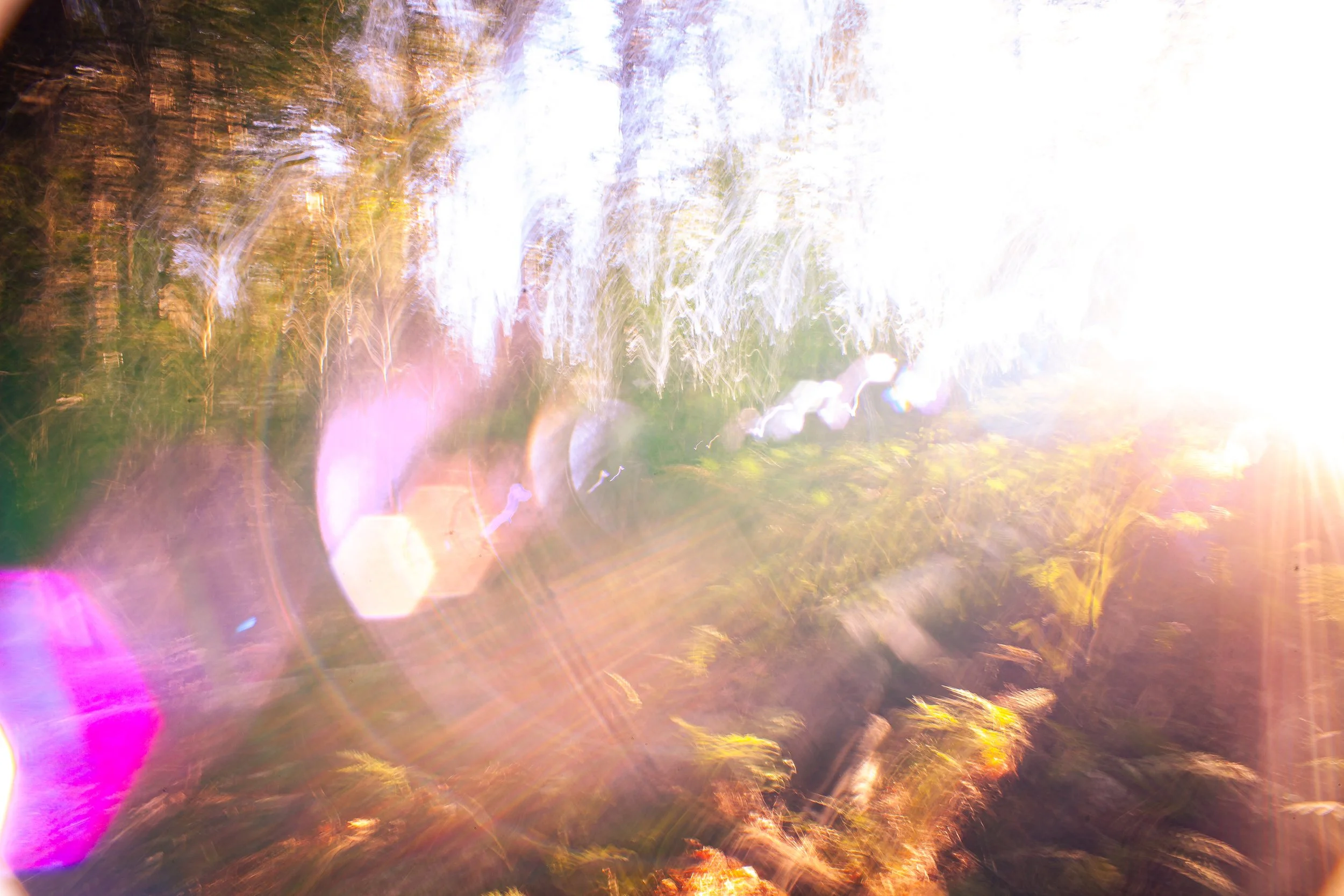
Photograph by Rod Lamborn
Genius Loci began when artist Corinna Springer invited photographer and filmmaker Rod Lamborn to collaborate. The idea was simple: what might happen if two different visual languages were brought together to reveal what ordinarily remains unseen?
Springer approaches this question through painting, symbolic language and contemplative practice; Lamborn through photography, movement and an intuitive relationship between body, camera and environment. Neither knew what form the collaboration would take, but its subject was clear: the place Springer calls home, a hamlet in New York’s Catskill Mountains affectionately referred to as “the mountain.”
Both artists had already accumulated imagery capturing the raw beauty of this place. Meeting again in August 2026, they began experimenting—painting symbols onto camera filters, photographing through them, moving the camera through sunlight and landscape, and allowing paintings, photographs and new material to enter into conversation. Rather than illustrating a predetermined concept, the project was allowed to reveal its own life through making.
What emerged is an exploration of perception and participation. Genius Loci asks whether reality is something we merely observe, or something we continually encounter and help shape through what we perceive, the meaning we assign to it, and how we participate.
Hebrew letters, ancient symbols, geometric forms, paintings and fragments of landscape become lenses through which habitual perception might be interrupted, opening the possibility of meeting reality from a place of greater unity and peace. Springer’s symbolic language meets Lamborn’s moving camera, allowing light, form and landscape to conceal and reveal one another.
The mountain becomes both subject and participant—a living field in which apparent opposites such as light and darkness, inner and outer, observer and observed become aspects of a larger whole. Genius Loci, “spirit of the place,” points to this presence.
Through the film and fifteen accompanying images, Genius Loci proposes a visual language that incorporates the hidden layers of reality. If perception participates in shaping our experience, changing how we see may also change how we meet the world.
The project is ultimately an invitation to look again: to realize that the boundaries between inner and outer reality may not be as fixed as they appear.
Genius Loci borrows the accelerated visual language of contemporary media and turns its momentum inward. A tumultuous ascent through landscape, paintings, Hebrew letters, geometric forms and ancient symbols alternates with slower encounters with the mountain, creating tension between velocity and stillness, concealment and revelation.
Forms appear, disappear and return, sometimes too quickly to be consciously interpreted. Echoing the near-subliminal language of advertising and social media, the film redirects that intensity away from persuasion and consumption toward an interruption of habitual perception—an invitation to encounter the familiar and unfamiliar with fresh eyes.
Sound creates a parallel journey. A crystalline melody floats above cicadas and rushing water. Drumming, honoring the Indigenous peoples connected to this land, gradually dissolves into a heartbeat. What begins outside the viewer is drawn inward: seeing becomes sensing; observation becomes participation.
The ascent ultimately becomes a movement inward. Faced with the stark realities of everyday life, can we create a space between perception and reaction in which another response becomes possible? The film favors involution over revolution or revolt: turning inward not as withdrawal, but as a way of meeting the world differently, questioning our learned and inherited beliefs and reactions.
The mountain and the world remain the same; what may change is the way we are looking.

Dancing in the Rain I Genius Loci 2026
Photograph by Rod Lamborn
“The Vesica Piscis is one of the earliest and most important symbols in my practice. Its central form—the almond-shaped space created by the intersection of two circles—was the first symbol that emerged for me as a tool for consciously working with light and intention.
I began to understand this central space as a lens: a meeting point through which light can be received, concentrated and brought into form. Variations of this structure became embedded within my paintings, often combined with letters and other symbols. Sometimes visible and sometimes concealed beneath layers of paint, it functions as part of the underlying architecture of the work.
In Genius Loci, the Vesica Piscis takes on another role. It appears repeatedly throughout the film, marking successive stages of encounter and transformation. Here it is placed directly on the camera filter, becoming a literal lens within a lens through which the landscape and its light are received.
The photograph is called Dancing in the Rain. Although what appears to be rain is actually sunlight streaming through the image, I kept the title because rain itself carries an ancient association with mercy and blessing. Light appears as rain; geometry becomes a vessel; and what is ordinarily invisible briefly takes form.”
C.S